sup Gallop
http://karaoke.arirang.com.vn/butter.php?sand=tgu164atdg8c8
Farrand
Tuesday, July 19, 2016


Wednesday, May 23, 2012
(not the latest) Top Primary Schools in Singapore from Kiasu Parents
Please visit Kiasu Parents website at http://www.kiasuparents.com/kiasu/content/singapore-primary-schools-ranked-academic-excellence for the complete article and its methodology.

Thursday, February 10, 2011
Thursday, January 27, 2011
Unlikely to have Significant Drop in Property Prices
Channel News Asia: Significant drop in property prices unlikely: analysts
Jan 27
SINGAPORE : The recent government cooling measures in Singapore's property market will bring down sales volume, but not to the extent of causing a significant fall in prices.
According to a report by DTZ Research, sales volume is expected to fall as short-term speculators will be weeded out by the hefty seller's stamp duty of up to 16 per cent within the first year of purchase.
However, the property consultancy said not all investors will withdraw from the market.
Some may find the 4 per cent stamp duty by the fourth year of sale to be surmountable and shift their focus to buying uncompleted units with completion dates three to four years later.
DTZ's Executive Director for Residential, Margaret Thean said landed homes, small apartments and high-end apartments will be less affected by the measures. That's because small units with their low price quantum will continue to attract investors with spare cash or singles wanting their own units.
Thean added that the 4-year seller's stamp duty will have little impact on landed homes as most purchase them for long-term owner-occupation.
Meanwhile, high-end apartments will likely continue to see foreign interest.
DTZ added that prices in 2011 are expected to be largely stable with a decline of not more than 5 per cent.
This is underpinned by economic growth, low interest rates, strong holding power of developers, the appreciation of the Singapore dollar and inflow of foreign purchasers due to the property market clampdown in mainland China and Hong Kong.
The property consultancy does not rule out the possibility of more government measures should demand remain at a high level after a period of cooling-off.
The report also noted other challenges in the form of a spike in the number of completed units in a few years' time as the government is putting out a record high amount of units through the public housing and government land sales programmes.
There is also uncertainty over the strength of recovery of the major western economies.
If they recover well, interest rates will move up and reduce the affordability of mortgage payments.
On the other hand, if they continue to languish, this will have an effect on the Singapore economy and optimism in the property market eventually.
With the residential market facing numerous challenges, DTZ said investors are likely to take the extra effort to identify opportunities in other property sectors and alternative investment products.
Thursday, January 13, 2011
Latest round of cooling measures
Here are the latest round of Government property market cooling measures.
1. Sellers SSD increased from 3 to 4 years on sliding scale at 16% of selling price 12%, 8%, and 4%.
2. LTV lowered from 70 to 60% for 2nd and subsequent loans
3. 50% LTV for non individual buyers (exclude developers buying en bloc for redevelopment), e.g. corporations, trusts and collective investment schemes.
Full information can be found at: http://www.mas.gov.sg/news_room/press_releases/2011/Measures_To_Maintain_A_Stable_And_Sustainable_Property_Market.html
Monday, January 10, 2011
Top Schools = Top Students?
Recently I've seen an increasing emphasis on 'schools within 1km' criteria as being a deciding factor when it comes to purchasing a home. There is no denying that being in a good school brings about immeasurable benefits. Property investors may do well to sit up and take note of this factor when considering your next investment.
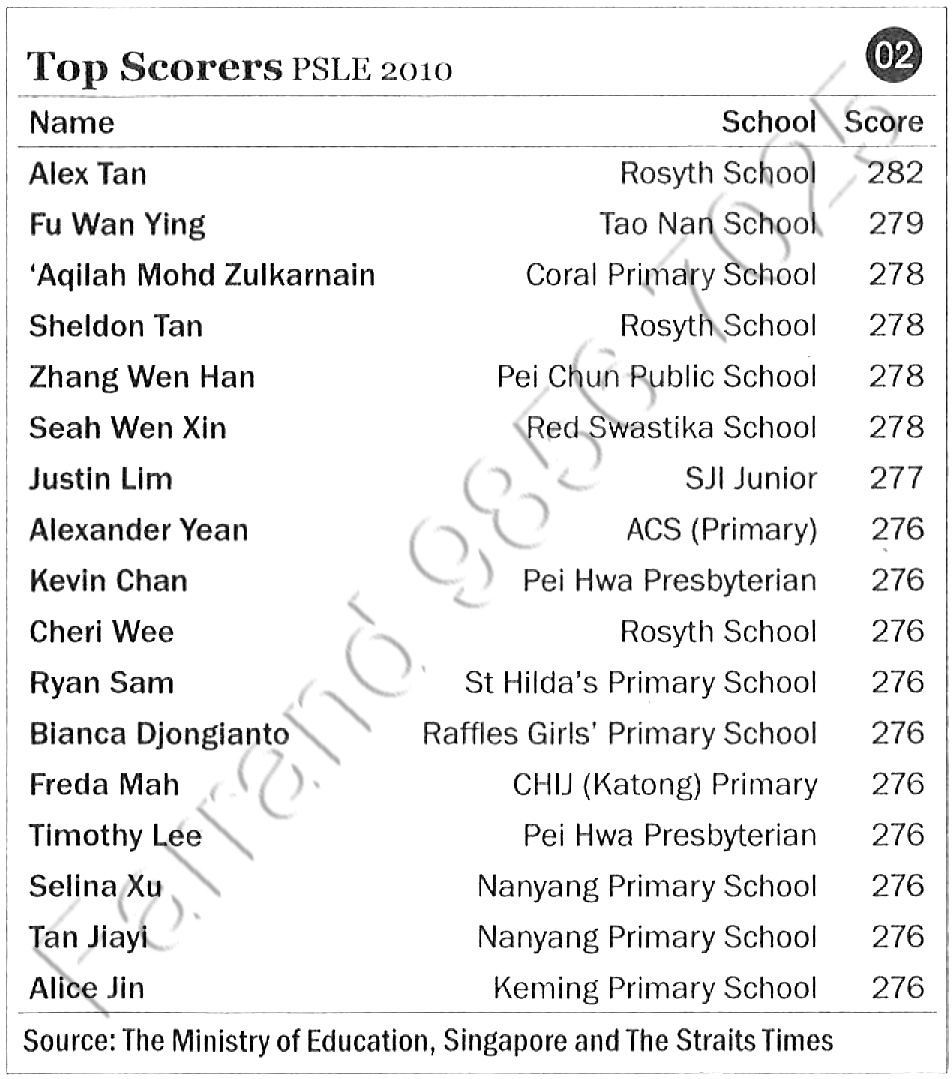 |
| Top Scorers for 2010 PSLE and their schools |
*Note: Gallop Gables is near to Nanyang and Raffles Girls' Primary School!
Sunday, January 9, 2011
Market Talk: CapitaLand
Below is an excerpt from
Straits Times: No shoebox flats for CapitaLand
By Cheryl Lim published on MON, JAN 10, 2011.
Straits Times: No shoebox flats for CapitaLand
By Cheryl Lim published on MON, JAN 10, 2011.
"At CapitaLand Residential Singapore, chief executive Wong Heang Fine noted that changing market dynamics would inevitably lead to smaller homes, but he stressed that the firm would not build flats under 500 sq ft. He said its focus for the year ahead would be on replenishing its land bank.
It has 2,500 launch-ready homes that have yet to be released for sale. It will launch 1,700 units this year, with the majority entering the market over the next three months.
At d'Leedon, more units will be released this year - 750 - with the first batch being rolled out this week. The remaining 390 units at The Interlace will be released soon after, followed by 55 luxury homes at The Nassim. Some of the 500 units set aside for the new development at the Bedok Town Centre site will also be launched this year, during the second or third quarter.
In addition, the 64 homes from the Urban Resort project at Cairnhill Road will come on stream this year. Units at both Urban Resort and The Nassim will be sold through private appointments.
Mr Liew indicated that CapitaLand had its eye on several collective-sale sites. He said it was also keen on residential sites - on both the confirmed and reserved lists - offered as part of the first half of this year's Government Land Sales programme.
Sites at the city fringe or near MRT stations would be high on CapitaLand's wish list.
Still, Mr Wong and Mr Liew agreed that even though CapitaLand's balance sheet was healthy enough to allow it to bid for all the sites it was interested in, it would do so with 'disciplined aggression'.
CapitaLand predicts that home prices are likely to increase by 5 to 10 per cent this year, with those in the high-end segment rising by 10 to 15 per cent.
Its optimism with regard to this segment has spurred it to market projects such as The Interlace in China and India.
It does not believe government measures will be introduced to curb foreign interest in the high-end market.
'Singapore is a very open economy. If we start to have such restrictions, it would destroy the image we have of being an open economy,' said Mr Liew."
Wednesday, November 17, 2010
Singapore's Economy to Expand 4% to 6% in 2011
The economy will continue to expand next year; extending an expansion that has already prompted the central bank to allow the currency to rise to a record to damp inflationary pressures.
Won't rising exchange rates coupled with already rock-bottom interest rates accelerate asset price inflation?
Won't rising exchange rates coupled with already rock-bottom interest rates accelerate asset price inflation?
A stronger Singapore Dollar might curb imported inflation but will also dampen exports & tourism. The Singapore Dollar has gained about 8 percent against the U.S. dollar this year, and closed at a record S$1.2835 on Nov. 4.
Tuesday, November 16, 2010
Property Market Update
October 2010 primary private sales market volume was up 16% month on month to 1,058 units compared to last month's 911 units - a rather strong recovery. Strong sales of 529 units of Executive Condominiums (EC) units contributed to the total primary market sales of 1,587 units in October. The strong sales were despite the Singapore government’s recent property cooling measures – suggesting HDB upgraders' demand could be stronger than expected.
Sales are again weighted to the Outside Central Region (OCR), though sales in Core Central Region (CCR) picked up to 21% of all new sales - driven mainly by two projects: The Glyndebourne and Suites at Orchard. Aborted sales options returned fell to 29 units from 65 units compared to the previous month, signaling less uncertainty in the market outlook. Sentiment certainly has improved markedly since the new measures were announced.
New sales since the beginning of this year now stands at 13,860 compared to 14,688 in 2009.
Recently launched projects in November like KeppelLand's Lakefront Residences (mass market:; average selling price of $1,020 psf) and UOL's Spottiswoode Residences (mid-market; average selling price of $1,700 psf) are witnessing healthy demand. However, pricing appears to be flat to marginally positive for new
launches, and secondary market volumes are down by an anecdotal 25%.
launches, and secondary market volumes are down by an anecdotal 25%.
Looking ahead, sales volumes could hold up but price growth is likely to remain muted. Also, it is likely that the government will continue to push out more land supply to cater to this demand - which will cap rhe mass market residential price growth. More onerous demand-side measures might be on the cards if prices rise sharply. The high-end residential market, which has been rather muted this year, will start to show more signs of life going forward and into 2011.
Thursday, October 28, 2010
BT: Jittery developers go low-rise on confidence
BT: Jittery developers go low-rise on confidence
By KALPANA RASHIWALA
By KALPANA RASHIWALA
The worst- kept secret in the property market is out in the open. Not only are developers less upbeat about the future but a third of them actually expect prices of new homes to decline. And market performance for the suburban residential sector may be the worst hit.
This dose of pessimism was reflected in the latest readings of Real Estate Sentiment Index (RESI) put out by the developers body and NUS.
In the wake of the Aug 30 cooling measures, some 34 per cent of developers polled for Q3 expect prices for new residential launches to decline, albeit by less than 10 per cent, over the next six months. None of the developers surveyed in Q1 and Q2 had predicted price drops.
Just 44 per cent expect more new residential units to be launched over the next half year, down from 68 per cent in the previous quarter.
The sentiment indices slipped below the psychologically significant mark of 5 in Q3, indicating respondents were less upbeat in the quarter and expect more uncertain market conditions over the next six months.
The consensus as indicated by net balances is generally weaker.
Polled on how the suburban residential sector would perform, the net balance in Q3 was -43 per cent. This means that most expect the sector to perform worse over the next six months. In Q2, this net balance was +27 per cent, hinting at better future performance.
'The strong historical price growth in the sector is not likely to be sustained moving forward. Downward adjustment to the price growth, if it occurs in the next few months, will ease some pressure on the affordability level of mass-market residential properties in suburban areas,' said Associate Professor Sing Tien Foo of NUS.
The net balance for the future market performance of the prime residential sector, while still in positive territory, has also been declining significantly, from +54 per cent in Q1 to +32 per cent in Q2 and +3 per cent in Q3.
About 70 per cent of the developer respondents in the latest survey were concerned that the government could intervene to dampen the property market further.
They also cited other factors that could hurt sentiment over the next six months. The concerns included a slowdown in the global economy (cited by 60 per cent), an increase in the supply of development land (53 per cent), too many new property launches (49 per cent), rising interest rates (47 per cent) and tightening financing/liquidity in the debt market (40 per cent).
Eighty-four per cent of all survey respondents consider it likely and very likely that there will be a further increase in the supply of development land over the next six months. An even higher proportion, 90 per cent, of respondents expect the government to further boost the supply of Build-to-Order and Design, Build and Sell Scheme public housing flats as well as executive condo (EC) units.
Recent government steps to cool the market are expected to have most impact on the HDB resale and mass private housing market segments. About 76 and 64 per cent respectively of survey respondents rated their impact on these two market segments over the next six months as significant. Conversely, the measures are expected to have the least impact on the high-end/luxury segment with 64 per cent predicting minimal impact. For the mid-end private housing segment, 79 per cent foresee only moderate impact.
Real Estate Developers' Association of Singapore and NUS' Department of Real Estate polled slightly over 70 respondents for their latest Q3 survey, similar to the size for the Q1 and Q2 surveys.
The Current Sentiment Index, where respondents are asked to rate overall Singapore real estate market conditions now compared with six months ago, fell from 5.8 in Q2 to 4.8 in Q3.
The Future Sentiment Index, where respondents rate overall property market conditions over the next six months, also slipped from 5.9 in Q2 to 4.8 in Q3. As a result, the Composite Sentiment Index (the average of the two indices), also declined to 4.8. The index ranges from 0 to 10 with a score below 5 indicating deteriorating market conditions.
Redas CEO Steven Choo said: 'The RESI was able to track closely the immediate impact the cooling measures has on sentiments in the property sector.'
Agreeing, Knight Frank chairman Tan Tiong Cheng said: 'The findings are not surprising. Just look at the amount of land government has been releasing and the supply of new HDB flats and ECs they're planning, plus the demand-side measures. People have put on their thinking caps to figure out how they'll be affected, whether they are HDB upgraders, buying a second/investment property, or even downgrading.
'The latest survey results are a clear signal to government that the measures are having an impact,' he added.
Separately, the NUS' Institute of Real Estate Studies yesterday released its monthly Singapore Residential Price Index tracking prices of completed non-landed private homes. The overall index rose one per cent month on month in September, slightly slower than the 1.1 per cent increase in August.
NUS' sub-index for Central region, which covers a basket of properties in districts 1-4 and 9-11, increased 0.6 per cent in September, the same pace as in August. The sub-index for Non-Central region appreciated 1.4 per cent in September, slightly slower than the 1.6 per cent gain posted in August.
Sunday, October 24, 2010
Farrer Road straightens!
ST: Farrer Road straightens out as MRT work ends
By Christopher Tan
Farrer Road is back to its original alignment after six years of twisty diversions necessary for construction of the Circle Line.
The busy thoroughfare has not only been straightened, but has also been widened. It now has four lanes each way, up from three.
With that, the traffic bottleneck which has been the bugbear of motorists since the construction started in 2004 has been removed.
'There should be significant improvement to traffic flow,' said retired traffic planner Joseph Yee, 65.
Farrer Road is part of the $400 million Outer Ring Road System, which currently allows motorists to travel over 20km from Tampines to Queensway with only two traffic lights along Lornie Road.
Workers were seen putting the finishing touches to the Farrer Road MRT station exterior last week.
The station is part of the remaining two stages of the Circle Line which will open by the middle of next year. The stages link Marymount to HarbourFront, passing places like the Botanic Gardens and Holland Village along the way.
A Land Transport Authority (LTA) spokesman said all 12 of the completed stations along this stretch are expected to achieve temporary occupation permits by the end of this year.
'The stations will then be architecturally fitted with electrical and mechanical works,' she added.
The Farrer Road station has one unique feature: a pedestrian overhead bridge with lifts at both ends.
This is to allow pedestrians to cross the road after train service hours, when the underground station - which forms an underpass across Farrer Road - is closed.
The LTA, however, said the bridge is not part of a plan currently under study to erect overhead bridges with lifts at selected MRT stations. It said that study had not been completed.
Ms Lee Bee Wah, an MP for Ang Mo Kio GRC, who has been lobbying for such facilities for three years now, hopes they will be built.
'I really hope they'll do it, especially if we want to encourage our senior citizens to be active and take public transport,' she said.
Two other roads diverted by Circle Line works - Holland and North Buona Vista - are expected to return to their original alignment in the next few weeks.
The busy thoroughfare has not only been straightened, but has also been widened. It now has four lanes each way, up from three.
With that, the traffic bottleneck which has been the bugbear of motorists since the construction started in 2004 has been removed.
'There should be significant improvement to traffic flow,' said retired traffic planner Joseph Yee, 65.
Farrer Road is part of the $400 million Outer Ring Road System, which currently allows motorists to travel over 20km from Tampines to Queensway with only two traffic lights along Lornie Road.
Workers were seen putting the finishing touches to the Farrer Road MRT station exterior last week.
The station is part of the remaining two stages of the Circle Line which will open by the middle of next year. The stages link Marymount to HarbourFront, passing places like the Botanic Gardens and Holland Village along the way.
A Land Transport Authority (LTA) spokesman said all 12 of the completed stations along this stretch are expected to achieve temporary occupation permits by the end of this year.
'The stations will then be architecturally fitted with electrical and mechanical works,' she added.
The Farrer Road station has one unique feature: a pedestrian overhead bridge with lifts at both ends.
This is to allow pedestrians to cross the road after train service hours, when the underground station - which forms an underpass across Farrer Road - is closed.
The LTA, however, said the bridge is not part of a plan currently under study to erect overhead bridges with lifts at selected MRT stations. It said that study had not been completed.
Ms Lee Bee Wah, an MP for Ang Mo Kio GRC, who has been lobbying for such facilities for three years now, hopes they will be built.
'I really hope they'll do it, especially if we want to encourage our senior citizens to be active and take public transport,' she said.
Two other roads diverted by Circle Line works - Holland and North Buona Vista - are expected to return to their original alignment in the next few weeks.
Tuesday, September 28, 2010
ST: The housing bubble trouble
A very good article and balanced views from Professor Joseph Gyourko, although I wouldn't agree with some of the points he raised. Much to learn from him.
---------------------------------------------------------------
ST: The housing bubble trouble
By Tan Hui Yee, Correspondent
In most parts of the world, a government that intervened in the property market three times in one year would heighten uncertainty.
But not so in Singapore, observes Professor Joseph Gyourko, a housing economist from the University of Pennsylvania who was in town recently to speak at a forum conducted by the National University of Singapore's (NUS) Institute of Real Estate Studies.
He says: 'If the government gets into a habit of intervening all the time, it will harm market development. Investors won't want to invest because they can't be sure what the government is going to do Monday versus Friday.'
But the picture is clearly different in Singapore, he notes. The Government tried to temper speculation by abolishing developers' interest absorption schemes in September last year, and followed that with two additional rounds of measures in February and August this year that made it increasingly expensive for speculators to flip properties.
'You are sending a clear signal to investors that you are going to stop the price boom. The fact that you're doing the third round is a signal that you are going to do whatever it takes,' he says.
'And that actually may be providing clarity. You are telling everyone, 'Okay, we're just not stopping, we'll come up with something else down the road.''
This show of political will may just be what it takes to deflate Singapore's property bubble, he says.
Prof Gyourko, 54, knows bubbles intimately, having studied the sizzling property market in China and being privy to local developments as a board member of NUS' real-estate institute.
He believes home prices in Hong Kong, Singapore and China are being driven up by a mixture of real economic growth and short-term capital flows.
'Singapore's inflation rate is above the rate banks pay on deposits. When that happens, people want to put their money elsewhere. And one of the few alternative investments you can make is in housing.
'That's shifting a lot of money into homes. And that's not permanent or sustainable,' he says.
When the economy grows rapidly again, companies will ramp up production, the competition for capital will heat up, interest rates will rise - leaving over-leveraged property buyers in danger of defaulting on their loans. That could send property prices into a tailspin.
That said, he concedes that housing bubbles are by nature unpredictable, and the fact the Government here had to intervene three times indicates it had difficulty calibrating the measures required to tame the beast.
'Clearly, if the Singapore Government had known, it would have introduced Round Three right up front,' he says.
He rejects claims that rising property prices widen inequality, based on his experience in the United States market.
'The housing market is cyclical, so the claim is not true in the long run. In the US, when we had the boom...people were worried about wealth gains along coastal California and the East Coast of the US, which had the highest price rises. But prices cycle, and guess what?
They fell - by a lot. What generates long-run inequality are skill differences, not home ownership,' says Prof Gyourko.
He predicts property prices in Hong Kong, China and Singapore will take a hit in the next one to three years, effectively canceling out the gains owner-occupiers have made in the recent run-up.
'I don't worry about the fact that people got a bunch of capital gains because I think they are going to lose those capital gains,' he says, pointing out that these are paper gains.
But although property gains and losses even out over a lifetime, the resulting short-term frustrations may be hard to handle. 'It's easy for an academic to go, 'Don't worry, this stuff cycles.' If you are a politician, you've got to worry about that person being angry now because he has the vote, and you've got an election coming up.'
He acknowledges that while land in Singapore is scarce and property prices can be chased up without adequate control, the Government here has tried its best to make housing affordable through its public housing program.
'You guys do public housing about as good as it's done anywhere in the world,' he says. 'For such a small place, it's well-planned. It's affordable to people with modest incomes,' says Prof Gyourko.
But one suggestion he has is that Singapore could be more flexible about the housing grants or similar subsidies it gives households, to give them more freedom over what homes they can buy and where they can live.
Currently, subsidized households can use their housing grant of $30,000 to $40,000 to buy only HDB resale flats. With a voucher system, they would not be limited to government housing.
He also questions Singapore's system of allowing Central Provident Fund savings to be used to pay for homes. This encourages people to base a huge chunk of their retirement savings on the fortunes of the property market in a tiny country. In investment speak, this is considered 'undiversified'.
'That's a really risky thing to do. What happens if there is a housing market collapse?' he asks.
The Singapore property market has had its hairy moments: Housing prices plunged after the 1997 Asian financial crisis, although they have since bounced back and even surpassed 1996 levels.
Singaporeans, he says, have to understand that the CPF housing scheme amounts to an 'implicit subsidy' as it lowers the interest payable on bank loans by reducing a home buyer's loan amount.
'I view housing as a consumption good. I view it literally as 'I'm eating my house.'' That means retirement savings should be kept separate from housing expenditure, he says.
In his view, owner-occupied homes especially are not investments that can yield returns, so people should not devote their retirement savings to their homes in the hope of growing their money.
Asked about the attributes of an ideal housing system, he offers a verbal sketch of its key planks: It should be equitable, responsive and flexible.
This means society would have to determine some minimum quality of housing that everyone should be entitled to. Households that cannot afford to pay for this minimum standard would get subsidies. Poor households with children would get more subsidies because 'kids do not get to pick their parents, and thus, are not responsible in any way for their poverty'.
Ideally, housing supply should be plentiful, in the sense that the rules should allow developers to easily ramp up home building to meet increased demand.
This moderates housing prices, he says, as it will allow prices to be close to or at the level required to cover land costs, construction costs and a builder's usual profit.
Finally, an ideal system would offer different kinds of housing - including rental housing - to meet the needs of the population over its life cycle. It is also one where the population is 'educated on the true benefits and costs of the different types of housing'.
He accuses governments worldwide of a bias 'towards encouraging owning' homes instead of being upfront on the opportunity cost of doing that.
As a result, most people underestimate the costs of owning a property, he says. They forget the transaction costs of buying and selling a home are 'quite high', and it does not occur to them to set aside money for long-term maintenance.
Buyers also risk getting stuck with their homes if a sharp drop in prices pulls the value of their homes below the mortgage amount.
Unless a home owner in such a predicament has enough cash to make up the shortfall, he cannot move house. Some academics have fingered such 'underwater' mortgages as a possible explanation for stubbornly high unemployment figures in the US, as it means people living in declining cities cannot move to places where jobs are more plentiful.
In Singapore, which takes just about an hour to cross by car, the problems posed by such immobility are less serious. Still, he thinks being stuck in such 'underwater' homes could result in longer commutes to workplaces and stop families from moving close to the school they want their children to attend.
Prof Gyourko - a home owner himself in Philadelphia - is careful to declare he has nothing against home ownership, especially as it makes someone a stakeholder in his community. In the case of Singapore, it makes one a stakeholder in the nation.
But the goal of the Government should be to get people to 'make the right choice about owning versus renting, not that owning always is better'.
In sum, housing choices should follow people's needs over their lifetime, instead of determining how they have to live their lives.
Young people, he says, make 'natural renters' instead of home buyers because this arrangement allows them to respond quickly to changing circumstances.
'You can move to opportunity. You can get married. You can do all types of different things instead of being stuck in a house,' he says.
Monday, September 27, 2010
Bloomberg: H.K. Builders May Offer Financing to Counter Curbs
Sept. 28 (Bloomberg) -- Hong Kong developers may offer property buyers secondary financing to counter government market-cooling efforts that have cut transactions by about a third, the city's two biggest real-estate brokers said.
Cheung Kong Holdings Ltd., the builder controlled by billionaire Li Ka-shing, is providing buyers at its Oceanaire project in the Ma On Shan district in the city's north with as much as 10 percent additional financing on top of their bank mortgages, the company said in a Sept. 21 statement.
Home transactions in the city have contracted about 33 percent since Aug. 13 when the government raised down-payment ratios and pledged to increase land supply to rein in home prices, according to Centaline Property Agency Ltd. The government has said it may introduce more measures to curb home values that have surged about 47 percent in 21 months to the highest since the last peak in 1997.
For the full article, please visit www.Bloomberg.com
Cheung Kong Holdings Ltd., the builder controlled by billionaire Li Ka-shing, is providing buyers at its Oceanaire project in the Ma On Shan district in the city's north with as much as 10 percent additional financing on top of their bank mortgages, the company said in a Sept. 21 statement.
Home transactions in the city have contracted about 33 percent since Aug. 13 when the government raised down-payment ratios and pledged to increase land supply to rein in home prices, according to Centaline Property Agency Ltd. The government has said it may introduce more measures to curb home values that have surged about 47 percent in 21 months to the highest since the last peak in 1997.
For the full article, please visit www.Bloomberg.com
CNA - China announces rules to curb land hoarding
China on Monday unveiled new rules to curb land hoarding by developers, its latest efforts to pop a feared speculative bubble in the nation's soaring real estate sector.
Developers will be banned from bidding for more properties if they have lands idle for more than a year, illegally transferred lands, or developed land in breach of agreements, two Chinese ministries said.
Read more at http://www.channelnewsasia.com/stories/afp_asiapacific_business/view/1083641/1/.html
Tuesday, September 21, 2010
BT: Stage set for up market property launches
BT: Stage set for up market property launches
By UMA SHANKARI
By UMA SHANKARI
Developers here plan to launch another 34 residential developments with more than 8,800 units by June 2011, data compiled by Knight Frank shows.
Most of the new projects rolled out will be mid-tier and high-end developments. Knight Frank's list shows that 21 out of the 34 possible launches are located in the up market districts of 1, 2, 4, 9, 10 and 11.
Developers BT spoke to trust that the latest round of government measures to dampen demand for private homes and HDB flats announced on Aug 30 will impact mostly mass market home buyers.
They are hopeful that new launches, which are mostly for homes in the mid-tier, high-end and luxury segments, will see healthy take-ups.
'I believe that the hardest hit projects will be the mass market ones,' said EL Development managing director Lim Yew Soon. 'For the mid to high-end projects, the impact will be somewhat lesser.'
The large number of upcoming mid-tier and high-end developments is not a reaction to the latest round of property measures, developers and analysts said. Rather, having pushed out numerous projects targeted at upgraders, many property groups are left with pending mid-tier and high-end project launches.
CB Richard Ellis executive director Joseph Tan said that many developers who bought mass market sites launched them within nine-12 months, with some even pushing out their projects in six-seven months to ride on the exuberant upgrader market.
'The fourth quarter will see more of the mid to high-end launches,' Mr Tan said.
Added one developer: 'Most developers rushed to launch mass market projects last year when that segment of the market was very hot, so there are mostly mid-tier and high-end projects that are waiting to be launched now anyway.'
But, many developers did not want to commit to a firm launch date - even though in some cases, show flats are ready and brochures have been printed.
CapitaLand recently said that it will go ahead with the launch of its new 1,715-unit condominium on the former Farrer Court site in Farrer Road by the end of this year.
The chief executive of the group's Singapore residential arm, Wong Heang Fine, said that while the new government measures have created some 'flux' in the market, things should 'settle in a couple of months'.
The launch of the Farrer Road project will be closely watched as it is the largest single residential development likely to be offered to home buyers in the near future.
CapitaLand is likely to hedge its bets by rolling out the development in phases, similar to what City Developments and the Hong Leong Group did with their 642-unit NV Residences in Pasir Ris.
EL Development's Mr Lim also said that he intends to launch his 115-unit freehold project on the site of the former Diamond Tower in Jalan Rajah, in the Balestier area, in Q1 2011. But, despite the more bullish outlook for the mid-tier and high-end segments, several large suburban projects will be launched soon.
Esparina Residences, a 573-unit executive condominium (EC) project at Sengkang by Frasers Centrepoint and Lum Chang Building Contractors, will be launched next month.
Major private suburban launches in Q4 2010 include Hoi Hup Sunway Property's 473-unit Vacanza @ East at Lengkong Tujoh; Far East Organization's 214-unit The Lanai at Hillview Avenue; and Keppel Land's yet-unnamed residential development at Lakeside Drive, which will have more than 600 units.
On Aug 30, the government said that it will now disallow concurrent ownership of HDB flats and private residential properties within the specified minimum occupation period.
Other measures were aimed at potential buyers of second homes. Those with an existing mortgage can now borrow only up to 70 per cent of a property's value for a second home, down from 80 per cent previously. They must also pay 10 per cent in cash, up from 5 per cent.
Developers and analysts said then that the measures will hit prices and sales of private homes, but mostly in the mass market segment.
Friday, September 17, 2010
TODAY: August NODX up 31%
August NODX up 31%
by Ephraim Seow Siew Lee | Sep 18
by Ephraim Seow Siew Lee | Sep 18
SINGAPORE - Singapore's non-oil domestic exports (NODX) surged last month by the most in nearly five years, driven by shipments of pharmaceuticals and electronics.
International Enterprise (IE) Singapore, said NODX grew 31.2 per cent last month compared to August last year, up from the revised 18.3 per cent increase in July. The stellar performance was the best since Dec 2005. On a month-on-month seasonally adjusted basis, August NODX rose 10 per cent, reversing the negative trend of the past three months. In July, NODX fell 3.9 per cent from the previous month.
To read the complete article, please visit http://www.todayonline.com
Thursday, September 16, 2010
TODAY: Property expert says prices may collapse by up to 50 per cent in the next year or two
30, 40, 50% drop?! That sounds a little preposterous and plucked from the sky...but who am I to argue with an expert.
---------------------------------------------------------------
---------------------------------------------------------------
Property expert says prices may collapse by up to 50 per cent in the next year or two
by Ephraim Seow Siew Lee | Sep 17
The dizzying rise in property prices here is not sustainable and the market may be heading for a hard landing in one to two years' time.
When that happens, property values may fall by as much as 50 per cent, according to an expert at a real estate forum yesterday.
Property experts speaking at the National University of Singapore's Institute of Real Estate Studies Forum said that excess liquidity in the market is the main factor that has been driving up property prices recently.
This liquidity may originate from prudent savings during the financial crisis, gains from the stock market run-up last year and foreign funds flowing here in search of better returns in Asian and emerging markets.
Mr Beat Lenherr, global chief strategist of LGT Capital Management, said: "I think that the money is finding a way around specific pointed measures and the money is just going to all the segments, micro-markets or micro-sectors."
Mr Lenherr also reckoned that the recent rally is not well supported and has been too fast, paving for a harder fall.
"If you look at the developments over the last four years, you clearly see elements of exaggerations where it doesn't make sense to buy in terms of rental yields or expected capital gains," Mr Lenherr added.
As such, he said property prices may "collapse by 30, 40 or 50 per cent" in the next one to two years.
Other speakers at the forum also said that the Singapore Government is still holding back on several other drastic measures such as the capital gains tax, which could dampen the property market abruptly if introduced.
They said the Government has so far been successful in building good neighbourhoods and community in its housing policies beyond controlling prices.
"I think the local market has been kept quite steady. I think the Government can indeed take pride in being able to making available affordable housing to more than 70 or 85 per cent of the masses," said Professor Bernard Yeung, Dean of NUS Business School.
TODAY: Improved economy, one of the factors for property prices?
So, we can expect higher psf, smaller units and smaller quantum going forward...
---------------------------------------------------------------
Improved economy, one of the factors for property prices?
by Rachel Adrienne Kelly | Sep 17
SINGAPORE - The recent property-cooling measures are not likely to have a significant long-term impact on the overall real estate market in Singapore, with global economic issues playing a larger role, property experts speaking at an industry seminar said yesterday.
"Generally, the property price is affected by external factors or the growth of the Singapore property prices is because of the improved economy. People's incomes increase, people's wealth increase, that's why they are buying," said Mr Alfred Chia, chief executive of SingCapital, at a forum organized by Propertyguru.com.
However, the Aug 30 property cooling measures are expected to reduce the cash-over-valuation (COV) of HDB resale flats and they will put a damper on demand for the rest of the year.
Market-watchers at the event expect COVs to decline by 10-per-cent this year from current levels, with a further 10 per cent drop next year.
Meanwhile, smaller properties are expected to be at a relative advantage.
"For people with a housing loan and on a tighter budget, they will have to lower their budget to buy another property," said Ms Chua Chor Hoon, head of Research, South East Asia at DTZ.
"That means if originally they were looking at a $1 million house, now they will have to look at something between $500,000 and $750,000 so you will see a shift in demand to smaller units," she added.
While the market adjusts to the new measures, the volume of mass market property sold is expected to decline by 10 per cent from now until the end of the year, according to some analysts' estimates.
No impact is expected in the high-end property market.
---------------------------------------------------------------
Improved economy, one of the factors for property prices?
by Rachel Adrienne Kelly | Sep 17
SINGAPORE - The recent property-cooling measures are not likely to have a significant long-term impact on the overall real estate market in Singapore, with global economic issues playing a larger role, property experts speaking at an industry seminar said yesterday.
"Generally, the property price is affected by external factors or the growth of the Singapore property prices is because of the improved economy. People's incomes increase, people's wealth increase, that's why they are buying," said Mr Alfred Chia, chief executive of SingCapital, at a forum organized by Propertyguru.com.
However, the Aug 30 property cooling measures are expected to reduce the cash-over-valuation (COV) of HDB resale flats and they will put a damper on demand for the rest of the year.
Market-watchers at the event expect COVs to decline by 10-per-cent this year from current levels, with a further 10 per cent drop next year.
Meanwhile, smaller properties are expected to be at a relative advantage.
"For people with a housing loan and on a tighter budget, they will have to lower their budget to buy another property," said Ms Chua Chor Hoon, head of Research, South East Asia at DTZ.
"That means if originally they were looking at a $1 million house, now they will have to look at something between $500,000 and $750,000 so you will see a shift in demand to smaller units," she added.
While the market adjusts to the new measures, the volume of mass market property sold is expected to decline by 10 per cent from now until the end of the year, according to some analysts' estimates.
No impact is expected in the high-end property market.
Wednesday, September 15, 2010
SIBOR drops to record 0.51%
This means cheap mortgage for home buyers, greater return for landlords, but dismal returns for cash holders.
My view is that it is as good as it gets...the rates can't really go much lower from here. The important question is how long this will last? Every Asian governments knows that we have a liquidity bubble going on here which is fueling asset price (specifically real estate, since other assets seem to be under performing).
Measures to dampen the property market have so far only a muted effect on prices but this could be the soft landing we are all hoping for.
CNA: Rental rates set to rise with 80,000 foreigners
Totally agree, rental units are being snapped up very quickly and at close to asking rent.
---------------------------------------------------------------
---------------------------------------------------------------
CNA: Rental rates in the private property market are poised to rise with the expected influx of some 80,000 foreign workers this year. Analysts said this is because of the shortage of private housing. And the supply situation may not improve this year as only 5,000 private housing units are expected for completion by year's end.
Read more at http://www.channelnewsasia.com/stories/singaporebusinessnews/view/1081453/1/.html
Subscribe to:
Posts (Atom)